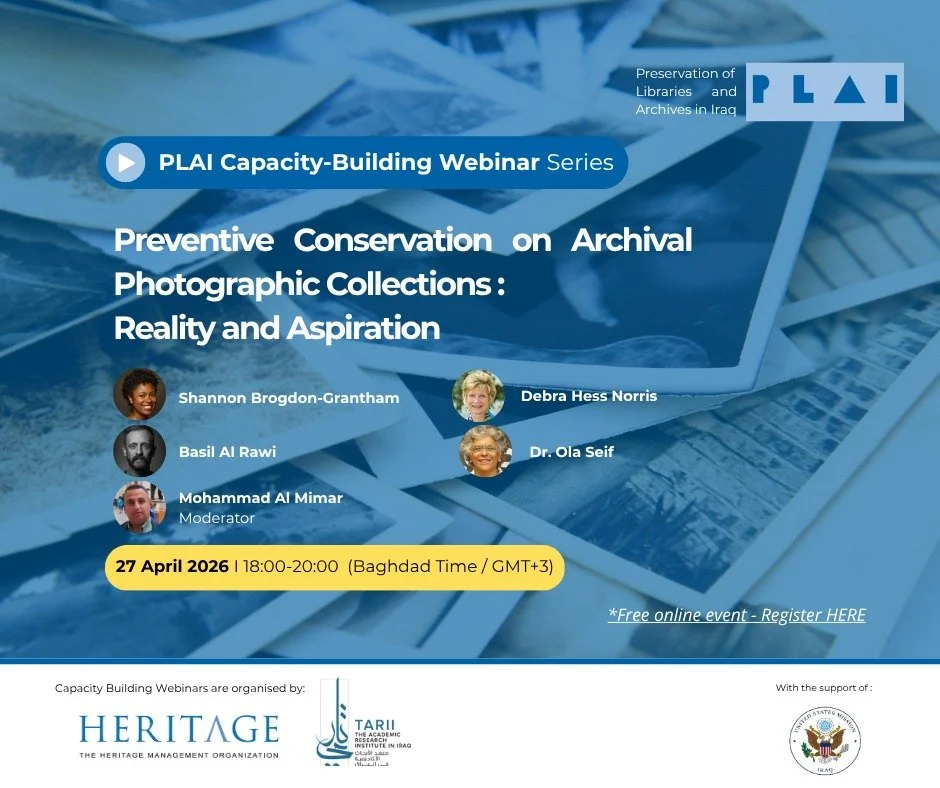
Preventive Conservation of Archival Photographic Collections: Reality and Aspiration
The next webinar in the PLAI program is open to the public! Simultaneous interpretations will be available. Registration is free but required.
EVENTS
The next webinar in the PLAI program is open to the public! Simultaneous interpretations will be available. Registration is free but required.
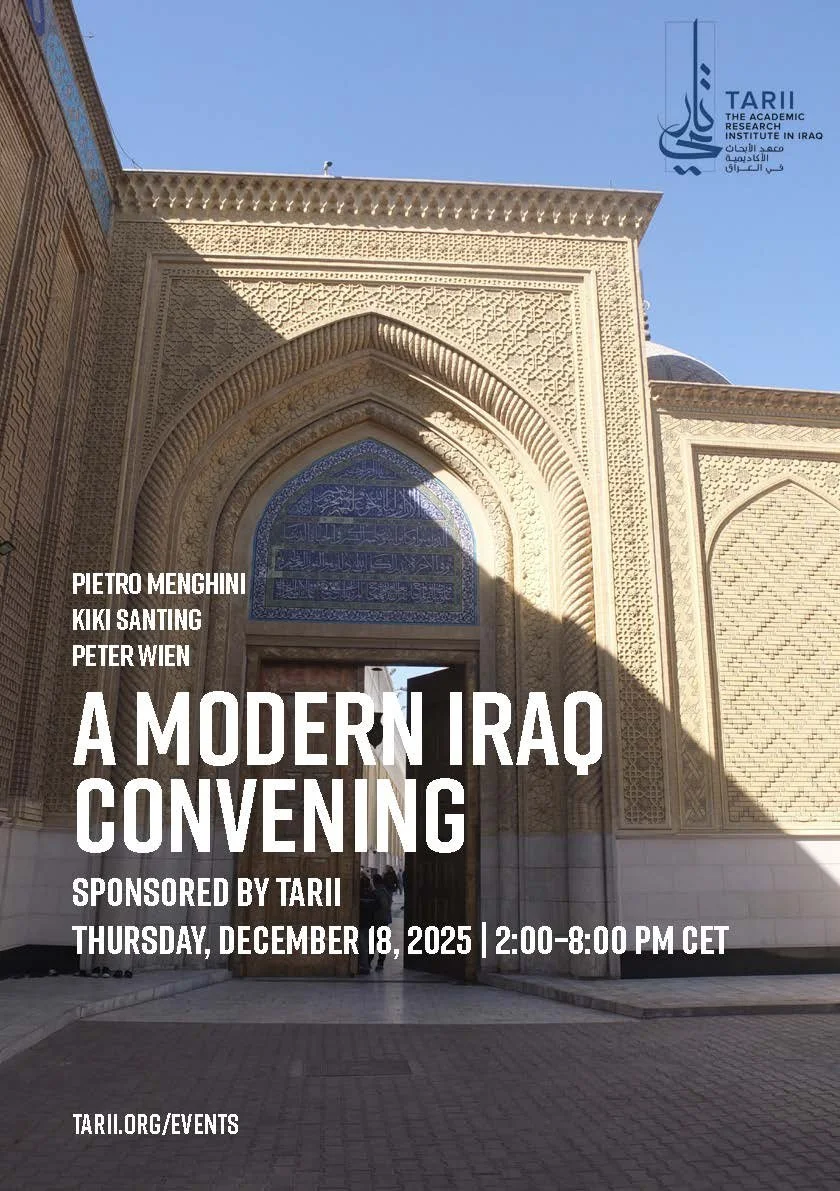
The Modern Iraq Convening brings together a new generation of international scholars sharing an interest in Modern Iraqi studies. All have carried out extensive fieldwork in or about Iraq. The objective of this day of presentations and discussion is to establish an international community of researchers focusing on Iraq in a multi- and cross-disciplinary fashion, in order to foster exchanges, encourage collaboration, and expand academic networking in the field. We hope our first convening can serve as the foundation for an annual meeting, either online or in-person, and for the establishment of an online platform on Iraqi Studies in dialogue with other Iraq-focused academic networks.
Attendance at this virtual event is free and open to all, but you must register to receive the Zoom link. This program will be conducted in English and will not be recorded.
Times are listed in Central European Time (CET)
Peter Wien
The Early Modern and the Modern - Thoughts on Iraqi Jews and the Archival Turn
Orit Bashkin
Chair: Kiki Santing
Assad Regime Archives: Between Transitional Justice and Historical Sources in the Shadow of Iraq
Michael Brill
The Role and Challenges of Cultural Studies in Understanding Modern and Contemporary Iraq
Antonio Pacifico
Ottoman Intellectuals and the Arab Renaissance in Iraq
Annie Greene
Treating the Nation: Public Health, Disease and the Body in Iraq 1930s-1970s
Rebecca Irvine
Idle Days and Nights: Leisure, Entertainment, and Everyday Life in Modern Iraq
Pelle Valentin Olsen
Chair: Pietro Menghini
The Sadrist Political theology of action
Fabio Merone
A socio-ethnographic approach of partisan domination in the Patriotic Union of Kurdistan’s controlled territories
Tom Préel
Human Rights According to the Iraqi Ba'th Socialist Party
Lily Hindy
Enshrining Division: The Origins of Ethno-Sectarian Power-sharing in post-2003 Iraq
Joseph Kotinsly
Chair: Peter Wien
State–Society Relations and the Politics of Infrastructure in Baghdad’s Sadr City
Ansar Jasim
Urban Resilience in Baghdad: How Actors Survive, Adapt, and Innovate Amid Prolonged Crises
Aleksandra Wojtaszek
Made in Iraq: urban planning, reconstruction, and change during international sanctions
Dorota Woroniecka-Krzyzanowska
Beyond the ‘Holy’: the Case of the Holy Cities in Iraq
Thibaud Laval
Shi`i City: The Najafi Cultural Revival and the Emergence of Modern Iraq
Christopher Cooper-Davies
Representative of the Ministry of Culture for Cultural Affairs, Dr. Fadel Mohamed Al-Badrani, and Director General of the National Library and Archives, Mr. Barak Raad Alawi
Iraq’s National Library and Archive and TARII held a discussion on the challenges that Iraqi and international scholars face working to preserve the modern history and art history of Iraq, and the significance of such efforts. Archives are an essential depository for the cultural memory of a nation and its people. Common legal access to archival evidence is an essential condition for Iraq and its uniquely diverse population to level the playing field for a fair, democratic, and pluralist negotiation of a shared past, present, and future.
TARII President, Dr. Peter Wien
For more than a century, scholars and artists have played a key role as Guardians of Memory in Iraqi society. The critical engagement with archival sources by trained academics, with the help of skilled archivists, archival administrators and specialists in archival preservation, helps to preserve the record of the past in all its complexity, safeguarding the nation against empty promises and the bending of facts to serve an agenda.
In our conversation, we discussed the history of Iraqi archives before and after 2003. We will explore the potentials of various archival collections in Iraq for research, and the possibilities of collaboration between Iraqi and Western researchers. We will examine the pressing challenges that Iraqi archives are facing today, we will look at measures that are already being taken to meet them, and we will discuss what still needs to be done. We will consider the role of state institutions and public universities in safeguarding fair and equal access to archives as heritage institutions
Dr. Nada Shabout, TARII Executive Committee member, gives remarks during the panel
The panel discussion was followed by an engaging discussion with the attendees.
Enjoy the beautiful scenic vistas along the Potomac River while supporting TARII!
Join us for the December Candy Cane run and a percentage of your registration fee will go to supporting us and our heritage and education initiatives. We look forward to seeing you there!
Race Start Times
10k – 7:45am
5k – 8am
Registration Fees
5k – $30, until Nov 30 ($35)
10k – $45, until Nov 30 ($50)
***Price will increase on race morning by $5 for each distance.
T-shirts are guaranteed to runners registered before Dec 11. T-shirts for those who register after that date will be available on a first-come first-served basis.
Race Medal Design
Race medal designs can be viewed on the Friday before the race on the Bishops Events Facebook page or their Instagram page.
Course Maps can be found at
https://bishopsevents.com/belle-haven/
This is a paved route with minimal elevation change. The 5k is an out-and-back in one direction, then heads the other direction along the Mount Vernon Trail. The 10k follows the same route as the 5k but continues another 1.55 miles before turning around for the 2nd time on the Mount Vernon Trail.
Walkers and strollers are welcome!
To register and for more information on awards, weather, facilities, a virtual race option, and more, visit: bishopsevents.com/event/2024-candy-cane-5k-10k/
This is a joint webinar between TARII and Iraq’s State Board of Antiquities and Heritage (SBAH), and funded by the JM Kaplan Fund as part of a future convening for Nimrud.
The ancient city of Nimrud, also known as Kalhu, was once the lavish capital city of a Neo-Assyrian empire that stretched from the Gulf to the Mediterranean around 800 BCE. Located just 20 kilometers south of Mosul, human habitation at Nimrud dates to the late fourth millennium BCE, and at its height in the ninth century BCE its ancient city walls encircled over 900 acres that included temples, palaces, elaborate monumental buildings, a ziggurat, and some of the most famous archaeological artifacts from Iraq.
Nimrud has suffered greatly from intentional destruction by Daesh. Since then, several teams have undertaken the crucial but daunting task to document and initiate recovery operations at Nimrud. At this point in time, it is critical that a holistic plan is developed for the site to ensure its future. In collaboration with Iraq’s State Board of Antiquities and Heritage (SBAH), TARII is convening a private meeting in Iraq for the development of this site plan. To prepare for this meeting, join SBAH and TARII for a virtual discussion on the current condition of the site, including presentations from the Nimrud Rescue training team, archaeologists, and Iraqi officials and scholars. Our goals are also to address the need to raise international awareness of Nimrud’s current state, highlight the efforts of SBAH, and mobilize support for its restoration and rehabilitation to be accessible again for visitors.
The webinar will be recorded with presentations in English and Arabic (simultaneous translations available). Registration for this Zoom event is required but free.
For more information like the program and speaker biographies, see the conference page.
The Bazaar of Erbil has two historic buildings called Qaysariyas. These separate roofed-structures were built by a wealthy merchant family from Erbil in the late 19th century for storing and selling high-quality goods.
Between 2011-2014 the Erbil Governorate and the Kurdistan Department of Antiquities, along with Germany’s TU Berlin and the German Archaeological Institute, collaborated on a documentation project. This project included a detailed survey of the buildings’ condition, an analysis of the damage, and a plan for restoring them according to preservation standards. The Kurdistan Regional Government plans to fully restore the entire structure based on the proposed preservation plan.
Sadly, these Qaysariyas are in bad condition and in danger, especially after the recent fire outbreak. Now a joint effort by the Erbil Governorate is underway to save them.
This conference and panel discussion, in collaboration with the University of Kurdistan Hewler, included a presentation by Dr. Anne Mollenhauer who was one of the leaders of the 2011-2014 Qaysariya survey.
G-CHeP and TARII held this convening in partnership with the University of Kurdistan Hewlêr
The Convening brought together members from the G-CHeP as well as local experts and partners to reflect on the past decade of conservation practice in Iraq and the Kurdistan Region. It was an opportunity to discuss current challenges in heritage protection, regional collaborations as well as new horizons in Iraqi Heritage.
To mark our new funding opportunity, TARII Heritage Grants, join us for a virtual question and answer session on Zoom!
TARII directors, Amanda Long and Lanah Haddad, will introduce the new grant program and address any questions about TARII’s fellowship programs.
We recommend that you consult our website to familiarize yourself with the programs before the event:
Take note that funding opportunities are awarded by committees, not by staff. Timing for this session will not be sufficient to provide specific feedback on proposals or applications. Such questions should be sent by email.
Join us at 11 am (Eastern) / 6 pm (Iraq) on Zoom:
https://us06web.zoom.us/j/84874733741
Registration is not required. The Q&A will be recorded.
You will be able to address your questions in English, Arabic, or Kurdish.
The TARII Heritage Grant Program is being funded by the JM Kaplan Fund.
The TARII Fellowship Program is being funded by the US Department of State through the Council of Overseas Research Centers (CAORC).
This session has been rescheduled for the 2022 MESA Annual Meeting; date and time to be determined
There is a common stereotype that Iraq is an artificial country, born out of colonial deal making, its borders merely “lines drawn in the sand.” Yet 100 years after the official creation of the Iraqi state during the Cairo Conference, under the chairmanship of Winston Churchill, Iraq still exists, despite several regime changes, decades under brutal dictatorial rule, and seemingly endless devastating wars, both civil and international. State violence and instability have displaced countless Iraqis inside and beyond the borders of the state. Most recently, the US-led invasion and the rise of Da‘sh have shattered the foundations of Iraq, cutting deep sectarian rifts into the social fabric. Yet despite this bleak outlook, a new generation of Iraqis recently took their fate into their own hands, both women and men, and staged a protest movement in the country’s major cities with an explicit commitment for a future Iraq as a nation for its people, regardless of ethno-sectarian background. The goals of the protest movement reflect the feelings of many generations of Iraqis, both in and outside the country, who worked tirelessly in the past to formulate an ethos of shared Iraqiness, negotiating a common space in the vibrant public sphere of a country that was shaped by conflict-laden yet creative and productive interactions in literature and poetry, in media, music, political parties, in art and architecture, in academia, and in a deep appreciation for the incomparable heritage of the country. For these women and men, the wealth of Iraq’s diversity is what continues to hold the country together against all odds.
Dr. Dina Khoury, George Washington University, Session Chair
Presenters:
Dr. Nadje Al-Ali, Brown University
Dr. Sinan Antoon, New York University
Dr. Qussay Al-Attabi, Kenyon College
Dr. Zainab Saleh, Haverford College
Dr. Nada Shabout, University of North Texas
Registration for the Middle East Studies Association’s Annual Meeting is required to attend this event. This year’s meeting will take place in Denver, Colorado with registration required by September 15.
THE TARII RESEARCH CONFERENCE
2022 Conference is co-sponsored by Freer Gallery of Art and Arthur M. Sackler Gallery, the Smithsonian's National Museum of Asian Art
The Academic Research Institute in Iraq (TARII) is pleased to welcome you to the TARII research conference. Join scholars and colleagues from across Iraq and internationally to hear about and discuss the various research being conducted in and on Iraq – from ancient to modern.
Space will be limited with registration required. Registration is free and available here through EventBrite. An evening reception will also be held with space limited.
Keep an eye on our conference page for further event and program information!
TARII has organized and will participate in a panel at the DOT 2022 meeting in Berlin, Germany. The specific date, time, and location of the panel will be updated here once available.
Panel Abstract:
On the occasion of the opening of its research facilities in Baghdad, TARII (The Academic Research Institute in Iraq) will lead a panel of a group of scholars and leading administrators affiliated with European research centers located in the Middle East or with deep networking ties to researchers in the region. We will discuss the role of overseas research centers in promoting the Humanities and Social Sciences in the past, present, and future. The panelists will present their respective institutions’ histories and present activities with an outlook to the future of their leadership structures, funding, and training and promotion of next-generation researchers. A particular emphasis will be on local and regional networking, national orientation versus international diversity, and benefit for the host countries. The goal of this panel is to consider the persistence of national research structures and whether they continue to make sense in times of budget reductions and growing demands for international collaboration, and to weigh the resulting questions in the light of a commitment that Western sponsored research should benefit local communities and empower them with regard to diversity and the promotion of justice and democracy in the public sphere. In this, debates are particularly relevant that concern difficult historical memories and the challenges that today’s societies are facing. Participants taking part in the panel next to TARII represent German, French, Dutch, Belgian, and Danish research institutes.
List of Participants:
Peter Wien (TARII)
Margarethe van Ess (DAI Baghdad)
Ulrike Freitag (ZMO Berlin)
Matthieu Rey (IFPO Beirut)
Harald Rosenbach (Max Weber Stiftung)
Kiki Santing (Dutch-Flemish Institute, Cairo)
Birgit Schaebler (OI Beirut)
Ingolf Thuesen (Danish Institute, Damascus)
Eckart Woertz (GIGA Hamburg)
Join scholars and colleagues from across Iraq and internationally to hear about and discuss the various research being conducted in and on Iraq – from ancient to modern. Due to continued health concerns, the conference will include this virtual component in October and then a conference at the Smithsonian’s National Museum of Asian Art in Washington, D.C. next year.
Each session will include presentations from scholars followed by a discussion, on subjects from archaeology and heritage preservation to archival research. Questions will be taken from the audience as well.
More information including biographies and abstracts will be regularly updated on our conferences page, here. Registration is free but required; registration is now open.
September 2, 2021
Photograph by Olivia Kuzio, Imaging Intern, MCI (Smithsonian Institution, 2019)
We invite you to join us for a continuation of our discussion in May as we welcome a new panel of scholars, who will speak about protecting sites and objects, conservation efforts, proper documentation, raising awareness within Iraq, and looting. More information is available on our Conferences page.
Dr. Zaid Alrawi
Dr. Zainab Bahrani, Dr. Abdulameer Al-Hamdani, Lanah Haddad, Dr. Mohammad Sabri, and Ali Ubaid
This event was held virtually on Zoom, recorded, and made available on our website afterwards.
Photograph by Olivia Kuzio, Imaging Intern, MCI (Smithsonian Institution, 2019)
Continuing with TARII’s cultural heritage preservation series, we will welcome a group of scholars to discuss the protection and preservation of Iraq’s ancient cultural heritage, moderated by Dr. Jean Evans. We are pleased to welcome Dr. Patty Gerstenblith, Dr. Abdulameer Al-Hamdani, Dr. Katharyn Hanson, and Riyadh Hatem Mohammed to this group discussion. They will discuss the current state of training, site security, museum storage and documentation, and object trafficking; and the role the international community has played and should play.
For those who could not join us live, a recording of this event is available online here.
Continuing with the series TARII began in late 2020, join us for a discussion on the protection and preservation of Iraq’s modern cultural heritage, which will be moderated by Dr. Peter Wien, TARII’s President. We are pleased to welcome Maysoon Al-Damluji, Dr. Geraldine Chatelard, Dr. Saad Eskander, Dr. Caecilia Pieri, and Dr. Nada Shabout to this group discussion.
During this event, we considered:
The importance of art, intangible heritage, and recorded memory in strengthening Iraqi communities on the national, regional, and local levels
The state of museums, libraries, and documentary collections in Iraq
Capacity building for curators, librarians, and archivists
Ways for Iraqi and international scholars to collaborate
Iraqi archives outside of Iraq
To learn more about this and the panelists, see the conference page for this event here.
For those who could not join us live, the discussion was recorded and is available here on our YouTube page.
An announcement for the third discussion in this series, Protecting Iraq’s Ancient Cultural Heritage: Training, Security, Storage and Documentation, and Object Trafficking, will be made soon.
Banner photo: Freedom Monument by Jawad Salim, Tahrir Square, Baghdad
TARII is pleased to introduce a new regular lecture series for our members! In partnership with the Embassy of the Republic of Iraq, this lecture series will be held at least twice a year either virtually or at the Embassy in Washington, D.C. It will be an opportunity to learn about the research being conducted by scholars in and on Iraq as well as a chance to network with others in the TARII community. As an introduction to this new series, the first lecture will be open to non-members as well.
Welcoming remarks will be given by Ahmed Utaifa, First Secretary, Head of In-Service and Development Section, Ministry of Foreign Affairs. Until recently Mr. Utaifa was the Legal and Cultural Affairs Officer at the Embassy of the Republic of Iraq in Washington, D.C. where he coordinated this new project with TARII. He has long worked in foreign service for Iraq and has lectured numerously on cultural heritage, world history, and cultural diplomacy. We look forward to Mr. Utaifa’s opening remarks to begin this series.
A recording of the lecture is available below.
Around 878 BCE, the Assyrian king, Ashurnasirpal II moved his royal capital from its ancestral site to a new location in the town of Kalhu (modern Nimrud, biblical Calah). There he initiated a building program of lavish palaces and temples that set the stage for 250 years of Assyrian royal arts that accompanied the expansion of the largest empire the world had seen to date. This talk provides an overview of the impressive achievements of these imperial arts, examining the architecture, sculpture, and carved reliefs from Kalhu and the subsequent two royal capitals at Dur Shurrukin and Nineveh.
Marian Feldman is the W.H. Collins Vickers Chair in Archaeology and holds a joint appointment in the Departments of the History of Art and Near Eastern Studies at Johns Hopkins University. She received her PhD in art history at Harvard University in ancient Near Eastern art and concentrates on the arts of the late third, second and first millennia BCE in the Near East and Eastern Mediterranean. Her interests range from questions regarding the role of the arts in cultural interactions and collective memory to issues of style, object agency, materiality and space.
Feldman’s first book, Diplomacy by Design: Luxury Arts and an ‘International Style’ in the Ancient Near East, 1400-1200 BCE (Chicago, 2006), investigates the role of artistic hybridity and luxury arts in international diplomacy during the Late Bronze Age. Her second book, Communities of Style: Portable Luxury Arts, Identity and Collective Memory in the Iron Age Levant (Chicago 2014), examines the ways communities form around -- and by means of -- art objects, focusing on portable luxury items (in particular, ivory and metalwork) in the first half of the first millennium BCE. Feldman has also co-edited several volumes, including Critical Approaches to Ancient Near Eastern Art (with Brian A. Brown; De Gruyter 2013), and is the author of several articles and catalogue essays. Her current book project investigates aspects of space, affect and agency in late third and early first millennium Mesopotamia.
Professor Feldman has held fellowships at the Institute for Archaeological Research (IAW) at the University of Freiburg (2019), the Internationales Kolleg Morphomata at the University of Cologne (2013), and the Center for Advanced Study in the Behavioral Sciences at Stanford University (2008-2009). She was recently a co-PI on the project “Material Entanglements in the Ancient Mediterranean and Beyond,” funded by the Getty Foundation “Connecting Art Histories” Initiative (2017-2020). She was a Getty Foundation “Connecting Art Histories” Visiting Professor at Bogaziçi University, Istanbul (March 2013) and a visiting professor at the University of Heidelberg (June 2010). She taught in the History of Art and Near Eastern Studies Departments at the University of California, Berkeley, before coming to Johns Hopkins in 2013.
This first lecture was open to members and non-members. Future in-person lectures in this series will be free for members and available to non-members for a small fee.
Following the release of Dr. Zahra Ali’s book, “Women and Gender in Iraq: Between Nation-Building and Fragmentation”, join Dr. Ali, Dr. Nadje Al-Ali, and Dr. Yasmin Chilmeran for a discussion on the role that women, feminist discourses, and gender norms have had on the Iraqi uprising. The discussion will be led and moderated by Dr. Dina Khoury.
To learn more about this and the speakers, see the conference page for this event here.
A recording of the event is available here.
Transcriptions and translations will be made available on our Conferences page in future.
This event was co-sponsored by Cambridge University Press
Sponsored by The Academic Research Institute in Iraq (TARII), this colloquium session at the Archaeological Institute of America (AIA) will be offered in honor of the memory of Dr. Lamia Al-Gailani Werr, an internationally recognized scholar and one of Iraq’s first female archaeologists. Dr. Al-Gailani was also the first woman from the Iraqi government’s Antiquities service to serve as an official representative on a foreign expedition.
As one of the first Iraqi women to run her own dig (Tell adh-Dhibai) and as the British Institute for the Study of Iraq (BISI)’s only honorary lifetime member, her legacy reaches into every aspect of the cultural heritage community in Iraq and internationally. Her scholarship and advocacy will have a lasting impact on generations of scholars.
Dr. Lamia Al-Gailani Werr died on January 18, 2019 at the age of 80. This collection of papers and discussion will focus on Dr. Al-Gailani’s work in Iraq and London to include both her scholarship, advocacy, her role as an advisor, and her legacy in projects that continue.
Speakers:
Dr. Abdulameer Al-Hamdani
Dr. McGuire Gibson
Dr. Katharyn Hanson
Dr. Amy Gansell
See the AIA annual meeting program, available here, for a full schedule of sessions and for the presentation abstracts of our speakers. You must register to attend the AIA annual meeting in order to join this or any other session during this annual meeting.
Photo credit: NPR.org
TARII organized a conversation about Iraq’s cultural heritage moderated by Dr. Katharyn Hanson. We welcomed Maysoon Al-Damluji, Dr. Abdulameer Al-Hamdani, Dr. Patty Gerstenblith, and Dr. Nada Shabout for this webinar discussion.
Photograph by Olivia Kuzio, Imaging Intern, MCI (Smithsonian Institution, 2019)
The scholars discussed:
Key issues for Iraq’s cultural heritage today
The progression of cultural heritage research
The role of the international community
The trafficking of cultural heritage objects and artifacts
The preservation of modern art and historic architecture
Effects of the global pandemic
See the Conference page for this event for more information about the panelists and other relative conferences.
This webinar was held over Zoom. For those who could not join us, the discussion was recorded and available via YouTube here.
TARII is pleased to sponsor a panel at this year’s Middle East Studies Association (MESA) Annual Meeting.
Modern Iraq is predominantly studied as a site of war, imperial plunder, political upheaval and militarized occupation. Indeed, these conditions and their consequences have profoundly shaped life for Iraqis inside and outside of the country. What are the salient social, cultural and political spheres that have emerged in order to imagine and organize life in Iraq under such conditions? Specifically, how has modernity been differently imagined and experienced across various institutions of social, cultural and political life in Iraq over the last century? This panel foregrounds the range of methods through which we can address these questions. Papers address various approaches including textual analysis, biography, archival research, and ethnography to examining social, cultural and political formations of the nation-state under conditions of post-war occupation and revolution at distinct historical moments: First World War, anti-colonial struggles during the mid-twentieth century, and present day. Drawing together interdisciplinary perspectives, the panel will stimulate a broad dialogue based upon in-depth perspectives on modern life in Iraq from political activism, legal systems and infrastructure, to cinema and narrative fiction.
Mona Damluji - Chair
Khaled Al Hilli - Presenter:
Literary Cartography: Mapping National Space and Spatializing Memory in Contemporary Iraqi Fiction
Mona Damluji - Presenter:
Oil Infrastructure and Cinema in Iraq
Sara Pursley - Presenter:
The Sectarianization of Family Law during the British Occupation of Ottoman Iraq
Zainab Saleh - Presenter:
British Empire and the Construction of Revolutionary Subjectivity in Iraq
Toby C. Jones - Discussant
More information, including paper abstracts, biographies, and registration details can be found on the MESA website.
A recording of this lecture is available below.
Poetry has long dominated the cultural landscape of modern Iraq, simultaneously representing the literary pinnacle of high culture and giving voice to the popular discourses of mass culture. As the favored genre of culture expression for religious clerics, nationalist politicians, leftist dissidents, and avant-garde intellectuals, poetry critically shaped the social, political, and cultural debates that consumed the Iraqi public sphere in the twentieth century. The popularity of poetry in modern Iraq, however, made it a dangerous practice that carried serious political consequences and grave risks to dissident poets.
The Dangers of Poetry is the first book to narrate the social history of poetry in the modern Middle East. Moving beyond the analysis of poems as literary and intellectual texts, Kevin M. Jones shows how poems functioned as social acts that critically shaped the cultural politics of revolutionary Iraq. He narrates the history of three generations of Iraqi poets who navigated the fraught relationship between culture and politics in pursuit of their own ambitions and agendas. Through this historical analysis of thousands of poems published in newspapers, recited in popular demonstrations, and disseminated in secret whispers, this book reveals the overlooked contribution of these poets to the spirit of rebellion in modern Iraq.
Moderator: Dr. Peter Wien is President of TARII and Professor for Modern Middle Eastern History at the University of Maryland in College Park. He received his PhD in 2003 from the University of Bonn, Germany, and Master degrees from the University of Oxford, UK, and the University of Heidelberg, Germany, in 1999. He taught at Al-Akhawayn University in Ifrane, Morocco, and was a fellow of the Centre for Modern Oriental Studies in Berlin. His publications include the books Arab Nationalism: The Politics of History and Culture in the Modern Middle East (London: Routledge, 2017), and Iraqi Arab Nationalism: Authoritarian, Totalitarian and Pro-Fascist Inclinations, 1932-1941 (London: Routledge, 2006).
Author: Dr. Kevin Jones is Assistant Professor of History at the University of Georgia. He earned his PhD in History from the University of Michigan in 2013 and was a Post-Doctoral Research Fellow at the George Washington University Institute for Middle East Studies in 2013-2014 before beginning his current position at the University of Georgia. His work on Iraqi cultural history and Middle Eastern labor history has appeared in Social History and his new book, The Dangers of Poetry: Culture, Politics, and Modernity in Iraq, was published by Stanford University Press in September 2020. The book traces the history of poetry, political protest, and public performance in modern Iraq and demonstrates the unique contribution of nationalist and communist poets to the cultural politics of anticolonialism and national liberation in the twentieth century.
Discussant: Dr. Sara Farhan is an Assistant Professor of History in the Department of International Studies at the American University of Sharjah; and a Michael Ellis DeBakey History of Medicine Fellow at the National Library of Medicine. She earned her PhD in History from York University in 2019.
This event was co-sponsored by Stanford University Press
Interested in the book? Check out their website here.
Join us for our annual Reception at MESA!
This is a great opportunity to learn more about TARII by meeting and socializing with TARII staff, Board members, individual members, and our colleagues. Join us for some food, drinks, and great conversation!
We will be at the Palace Café’s Black Duck Bar, a very short walk from the MESA Annual Meeting hotel.
Please join us for our Roundtable at MESA!
Abstract:
Due to the ongoing legacies of sanctions, authoritarianism, violence, and foreign interventions we have now suffered over 20 years of disconnect between international scholars, who do research in Iraq studies, and their ability to conduct that research inside of Iraq. Following on The Academic Research Institute in Iraq (TARII)’s recently established Center for Research in Baghdad we propose a roundtable to review the state of Iraq Studies in all disciplines and how our research center in Baghdad can contribute to the future of the field. TARII is a registered non-profit devoted to promoting scholarly research on and in Iraq and to strengthen relationships between Iraqi and American scholars and institutions. At this time in particular, Iraq’s important role on the world stage necessitates facilitating research on Iraq with a full and accurate context that can be best accessed inside Iraq. With this panel we hope to provide the opportunity for a robust discussion covering Iraqi history, contemporary politics, cultural heritage, and cultural production across disciplines today.
Roundtable Chair: Peter Wien
Speakers:
Nabil Al-Tikriti
Katharyn Hanson
Alda Benjamen
Antoine Borrut
Matthieu Rey
This conference will address a range of subjects from disciplines including history, anthropology, literature and cultural studies, as well as political science that investigate the diversity of social, cultural, economic and political locations of tribal life, as well as evocations, and interpretations of tribalism in the Middle East in past and present. The geographical focus of the conference will be limited to Iraq, Yemen, and Jordan/Syria in order to facilitate debate and enhance comparability on the one hand, and because of the particular currency of these geographical boundaries in the contemporary Middle East. Chronologically, papers will focus on the modern period from the 19th century to the present day, while some participants might be invited to address long-term perspectives in their papers.
The two-day conference is co-sponsored by TARII, the University of Maryland, and the American Institute of Yemeni Studies (AIYS).
For more information and to RSVP, visit tribesumd.com.
One of the most costly and aggressive interventions in American history, the invasion and occupation of Iraq in 2003 ushered in an era of state collapse, insecurity, ethno-religious violence, and new forms of authoritarianism culminating in the rise of ISIL in 2014. Current narratives of Iraq have eschewed tackling questions of transitional justice and post-conflict peace building. This workshop brings together leading experts on Iraq to explore how Iraqi state and society relations can benefit from peace-building paradigms as mechanisms for addressing stalled democratization.
For the flyer and more information, click here.
For the agenda and presentation abstracts, click here.
Are you attending the Middle East Studies Association meeting in San Antonio this year? If so, please join TARII on Saturday evening to meet others interested in Iraq and Mesopotamian studies. All are welcome!
On Saturday, May 5, 2018 from 10:00 am - 4:00 pm, the Embassy of the Republic of Iraq to Washington, D.C., will have the honor to join more than 75 other nations participating in Passport DC, opening its doors to the gracious public and the Iraqi community in the US during the Around the World Embassy Tour.
This year's Iraqi Embassy Tour will be showcasing traditional Iraqi music, costumes, art, painting, ancient Mesopotamia, as well as the documentary, "Letters from Baghdad: The True Story of Gertrude Bell and Baghdad." It will also entertain guests with Iraqi traditional food.
The Academic Research Institute in Iraq (TARII) and the University of Chicago Oriental Institute will also participate in the Iraqi Embassy Tour.
TARII reception at MESA
The Middle East Studies Association (MESA) will hold its annual meeting at the Marriott Wardman Park Hotel in Washington, DC from November 18th to the 21st. The event will feature such topics as “Language and Identity,” “Tanzimat as Translation,” and more. TARII, based in Washington, DC, will be holding a reception at MESA and looks forward to welcoming attendees.
Join TARII for a reception on Saturday, November 18 at 8:30 pm!
Academic Panel: "Narratives of Co-existence and Pluralism in Northern Iraq"
Opportunities (Under Construction)
© 2026 The Academic Research Institute in Iraq