Nimrud: Rescue, Recovery, Restoration

The ancient city of Kalhu, today known as Nimrud, was once the lavish capital city of a Neo-Assyrian empire that stretched from the Gulf to the Mediterranean around 800 BCE. Located just south of Mosul in Iraq along the banks of the Tigris River, Nimrud provides evidence for how humans have flourished in this landscape for more than five thousand years. At the pinnacle of its development, Nimrud’s ancient city walls encircled over 900 acres that included temples, palaces, elaborate monumental buildings, a ziggurat, and some of the most iconic archaeological artifacts ever discovered in Iraq. A site of great cultural significance, locally and internationally, the Republic of Iraq first listed Nimrud on its tentative list for World Heritage inscription in 2000.
The famed architectural remains, carved reliefs, and sculptures of giant winged lions and bulls were all still standing at the site prior to 2015. Sadly, Nimrud suffered greatly from intentional destruction by Daesh. First publicized in a 2015 Daesh propaganda video, this damage involved sledgehammers, jackhammers, and earthmoving equipment to deface and break up the ancient carved stone reliefs and sculptures. Later that year, Daesh detonated barrels of explosives in the Northwest Palace destroying many of its standing remains. There were three further destructive attacks in 2016 utilizing explosives and earth moving equipment, leveling significant sections of Nimrud, including the Tell.

As soon as the situation was stable enough, the government prioritized the site for repair, with efforts to secure and stabilize the site. Thus, the Smithsonian Institution supported the work of the Iraqi State Board of Antiquities and Heritage (SBAH) to conduct recovery and stabilization activities at and around the Northwest Palace of Nimrud from 2017 - 2024. This work focused on training Iraqis in new ways to protect and save their threatened heritage, as well as help enhance capacities of cultural heritage professionals to manage and operate cultural institutions following destruction caused by intentional damage and general neglect. The project was designed to provide urgently needed stabilization supplies and equipment to conduct the recovery work needed there, including salvage and safe storage of damaged heritage. This has been conducted by the Nimrud Rescue Team (NRT), a group of Smithsonian-trained Iraqi heritage specialists based at the SBAH Antiquities Office in Nineveh.
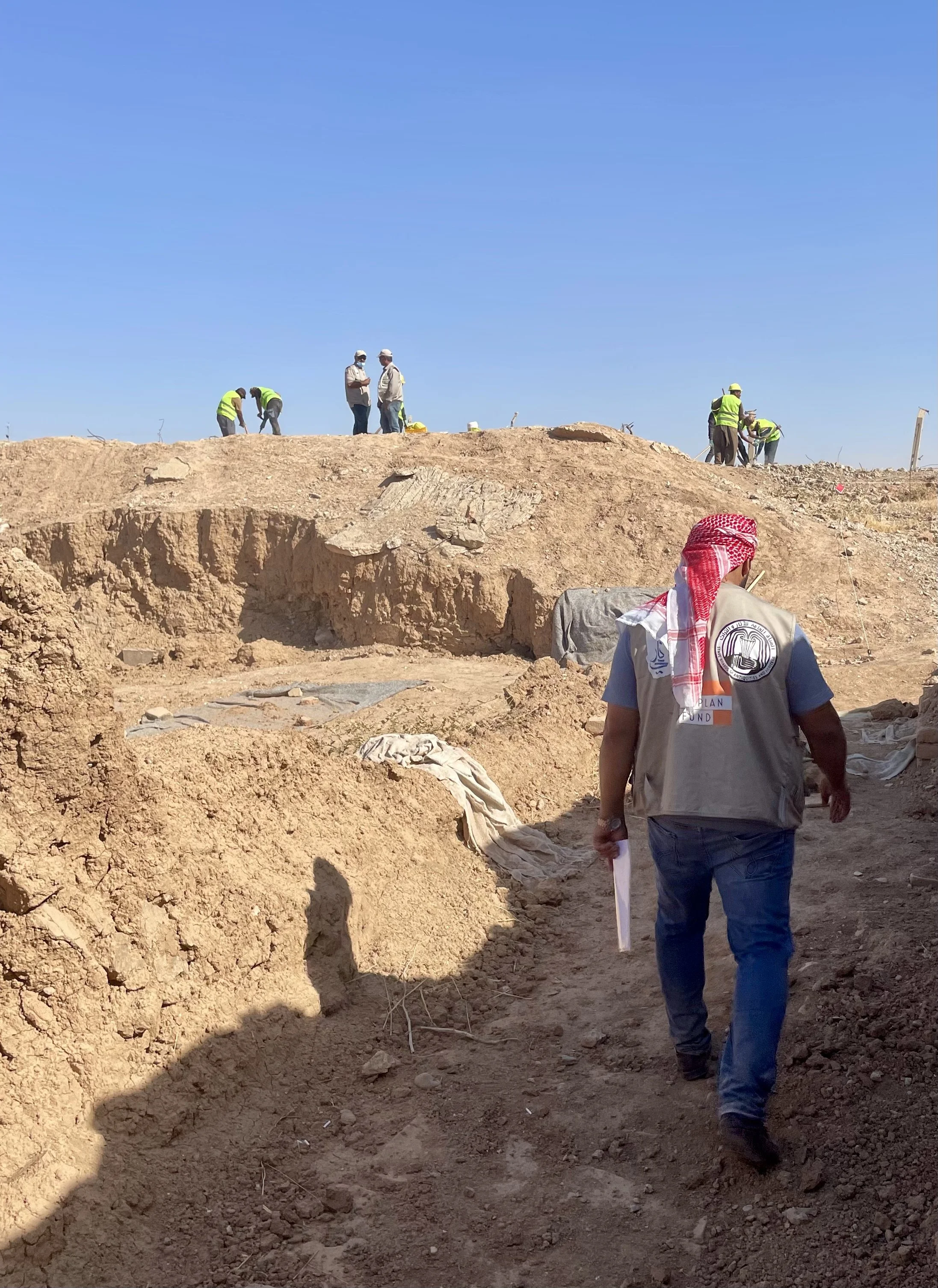
Beginning in 2022, TARII was contracted by the Smithsonian to facilitate and ensure the implementation of the project, procure supplies, and oversee the installation of equipment needed for the NRT to conduct their work. This collaboration continued in 2023 and 2024 with TARII implementing the full third and fourth seasons of the project.
Additionally, in 2024, TARII secured additional funding support from the JM Kaplan Fund to construct a large storage building to safely house the expansive collection of recovered objects and provide further space for documentation. This funding also allowed TARII and SBAH to convene meetings on the development and implementation of a holistic site plan, in order to ensure the long-term stability of the site and continuation of efforts there, while also ensuring a plan for its future. These meetings incorporated the expert opinions and feedback of international scholars, local archaeologists, officials, and long-time supporters. Through these meetings, SBAH decided the long-term plan for Nimrud is to restore the site and open it for tourism.
TARII and Iraq’s Nimrud Rescue Team are continuing the work together with a goal of implementing the site plan, first conducting an emergency stabilization season in 2025 again with the support of the JM Kaplan Fund. TARII continues to be a partner with SBAH for the future of Nimrud.

